- English
- 한국어
- Português
- русский
- Français
- 日本語
- Deutsch
- tiếng Việt
- Italiano
- Nederlands
- ภาษาไทย
- Polski
- Svenska
- magyar
- Malay
- বাংলা ভাষার
- Dansk
- Suomi
- हिन्दी
- Pilipino
- Türkçe
- Gaeilge
- العربية
- Indonesia
- Norsk
- تمل
- český
- ελληνικά
- український
- Javanese
- فارسی
- தமிழ்
- తెలుగు
- नेपाली
- Burmese
- български
- ລາວ
- Latine
- Қазақша
- Euskal
- Azərbaycan
- Slovenský jazyk
- Македонски
- Lietuvos
- Eesti Keel
- Română
- Slovenski
- मराठी
- Srpski језик
- Español

Why Is an HVAC Spool Copper Valve Automatic Assembly Line Becoming Essential for Modern Valve Manufacturing
As HVAC equipment continues to evolve toward higher efficiency, consistency, and production scalability, manufacturers are increasingly adopting automated assembly solutions. The HVAC Spool Copper Valve Automatic Assembly Line has become a critical technology for achieving precision assembly, reducing labor costs, and ensuring product quality. In this article, we explore how automated copper valve assembly systems work, their advantages, technical features, applications, and why companies such as Desheng are helping manufacturers transform production efficiency through intelligent automation.
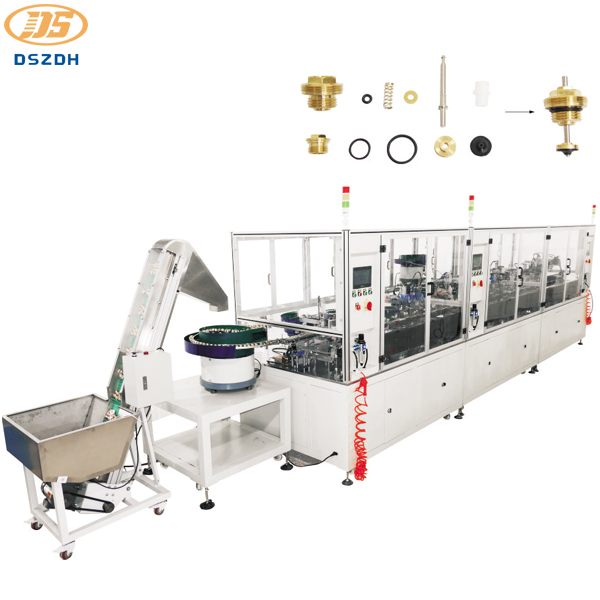
Table of Contents
- What Is an HVAC Spool Copper Valve Automatic Assembly Line?
- Why Automation Is Transforming HVAC Valve Manufacturing
- Key Components of the Assembly Line
- Main Working Process of the Automatic Assembly Line
- Technical Advantages of Automated Valve Assembly
- Performance Comparison: Manual vs Automatic Assembly
- Industries and Applications
- How Desheng Supports Smart Manufacturing
- Future Trends in HVAC Valve Automation
- Frequently Asked Questions
- Contact Us
What Is an HVAC Spool Copper Valve Automatic Assembly Line?
An HVAC Spool Copper Valve Automatic Assembly Line is an integrated manufacturing system specifically designed to automate the assembly of spool-type copper valves used in heating, ventilation, air conditioning, refrigeration, and fluid control systems.
The production line combines multiple automated stations including feeding, positioning, pressing, welding, inspection, marking, testing, and packaging. By replacing labor-intensive manual operations with intelligent automation, manufacturers can significantly improve production speed and assembly consistency.
Modern HVAC valve manufacturers require increasingly precise assembly tolerances. Even minor deviations in valve dimensions can affect fluid flow performance, sealing reliability, and overall HVAC system efficiency. Automated assembly lines address these challenges through advanced servo control and intelligent monitoring systems.
Why Automation Is Transforming HVAC Valve Manufacturing
The HVAC industry faces growing demands for higher production volumes, stricter quality requirements, and lower manufacturing costs. Traditional manual assembly methods often struggle to meet these expectations consistently.
Automation introduces several critical improvements:
- Reduced human error
- Higher production throughput
- Stable assembly quality
- Lower labor dependency
- Real-time production monitoring
- Enhanced product traceability
- Reduced manufacturing costs
As global HVAC equipment demand continues to rise, manufacturers are increasingly investing in intelligent assembly solutions to maintain competitiveness and ensure product reliability.
Key Components of the Assembly Line
A typical HVAC Spool Copper Valve Automatic Assembly Line consists of several interconnected modules working together seamlessly.
| Component | Function |
|---|---|
| Automatic Feeding System | Supplies copper valve parts continuously |
| Vibratory Bowl Feeder | Orients components accurately |
| Servo Assembly Station | Performs precision assembly operations |
| Press-Fit Module | Ensures accurate insertion force |
| Vision Inspection System | Detects defects and verifies assembly quality |
| Leak Testing Equipment | Checks valve sealing performance |
| Laser Marking Station | Provides traceability coding |
| Packaging Unit | Handles final product packaging |
Main Working Process of the Automatic Assembly Line
The entire production process follows a carefully controlled workflow designed to maximize efficiency and quality.
- Raw copper valve components enter the feeding system.
- Parts are automatically sorted and oriented.
- Valve bodies are positioned on precision fixtures.
- Spools and internal components are inserted.
- Press-fitting and assembly operations are completed.
- Critical dimensions are verified.
- Leak and pressure testing are performed.
- Vision systems inspect product quality.
- Laser marking adds identification information.
- Qualified products move to packaging.
Every station communicates through centralized PLC control, ensuring synchronization and real-time production data collection.
Technical Advantages of Automated Valve Assembly
Investing in an automated HVAC valve assembly line provides significant operational benefits.
1. Higher Precision
Servo-driven systems maintain micron-level positioning accuracy, ensuring consistent assembly quality across large production volumes.
2. Increased Production Capacity
Automated equipment can operate continuously with minimal downtime, dramatically increasing daily output compared with manual assembly.
3. Better Quality Control
Integrated sensors and machine vision systems continuously monitor product quality and immediately identify defects.
4. Reduced Labor Costs
One automated production line can replace multiple manual assembly stations, reducing workforce requirements while improving productivity.
5. Production Data Management
Modern assembly lines generate valuable manufacturing data for process optimization and quality analysis.
Performance Comparison: Manual vs Automatic Assembly
| Factor | Manual Assembly | Automatic Assembly Line |
|---|---|---|
| Production Speed | Low to Medium | High |
| Assembly Accuracy | Operator Dependent | Highly Consistent |
| Quality Stability | Variable | Excellent |
| Labor Requirement | High | Low |
| Traceability | Limited | Comprehensive |
| Defect Detection | Manual Inspection | Automatic Inspection |
| Long-Term Cost | Higher | Lower |
Industries and Applications
HVAC spool copper valves are widely used in numerous industrial sectors.
- Residential air conditioning systems
- Commercial HVAC equipment
- Heat pump systems
- Industrial refrigeration units
- Central cooling plants
- Fluid control systems
- Building automation solutions
- Energy-efficient HVAC installations
As environmental regulations continue to emphasize energy efficiency, the demand for high-quality copper valve components is expected to grow steadily.
How Desheng Supports Smart Manufacturing
Desheng specializes in customized automation equipment and intelligent assembly solutions for manufacturers seeking higher productivity and product quality.
Its HVAC Spool Copper Valve Automatic Assembly Line integrates advanced technologies including:
- PLC intelligent control systems
- Servo motion technology
- Machine vision inspection
- Automatic leak testing
- Data collection and traceability functions
- Flexible production customization
These capabilities help manufacturers achieve digital transformation goals while maintaining consistent product quality and reducing operational costs.
Future Trends in HVAC Valve Automation
The future of HVAC valve manufacturing will be increasingly influenced by Industry 4.0 technologies and smart factory initiatives.
Key trends include:
- Artificial intelligence-driven quality control
- Predictive maintenance systems
- Cloud-connected production management
- Digital twin technology
- Collaborative robotics integration
- Advanced manufacturing analytics
- Fully connected smart production lines
Manufacturers that embrace automation today will be better positioned to respond to future market demands and technological advancements.
Frequently Asked Questions
What products can be assembled using an HVAC Spool Copper Valve Automatic Assembly Line?
The system is designed for spool copper valves used in HVAC, refrigeration, fluid control, and related applications. Custom configurations can accommodate different valve designs.
How much can production efficiency improve?
Depending on product complexity and line configuration, automated assembly can often increase production efficiency by several times compared to manual operations.
Does the assembly line support quality inspection?
Yes. Modern systems integrate vision inspection, dimensional verification, pressure testing, and leak detection functions to ensure product quality.
Can the production line be customized?
Absolutely. Manufacturers frequently require customized fixtures, assembly processes, testing procedures, and software interfaces tailored to specific product requirements.
Is automation suitable for medium-sized manufacturers?
Yes. Many automation solutions are scalable and can be configured according to production volume, budget, and future expansion plans.
Contact Us
Ready to improve your HVAC valve manufacturing efficiency and product quality? The HVAC Spool Copper Valve Automatic Assembly Line from Desheng can help you achieve faster production, greater consistency, and lower operational costs. Whether you need a fully customized assembly solution or want to explore intelligent automation opportunities for your factory, our experienced engineering team is here to help. Contact us today to discuss your project requirements and discover how advanced automation can transform your manufacturing operations for long-term success.